
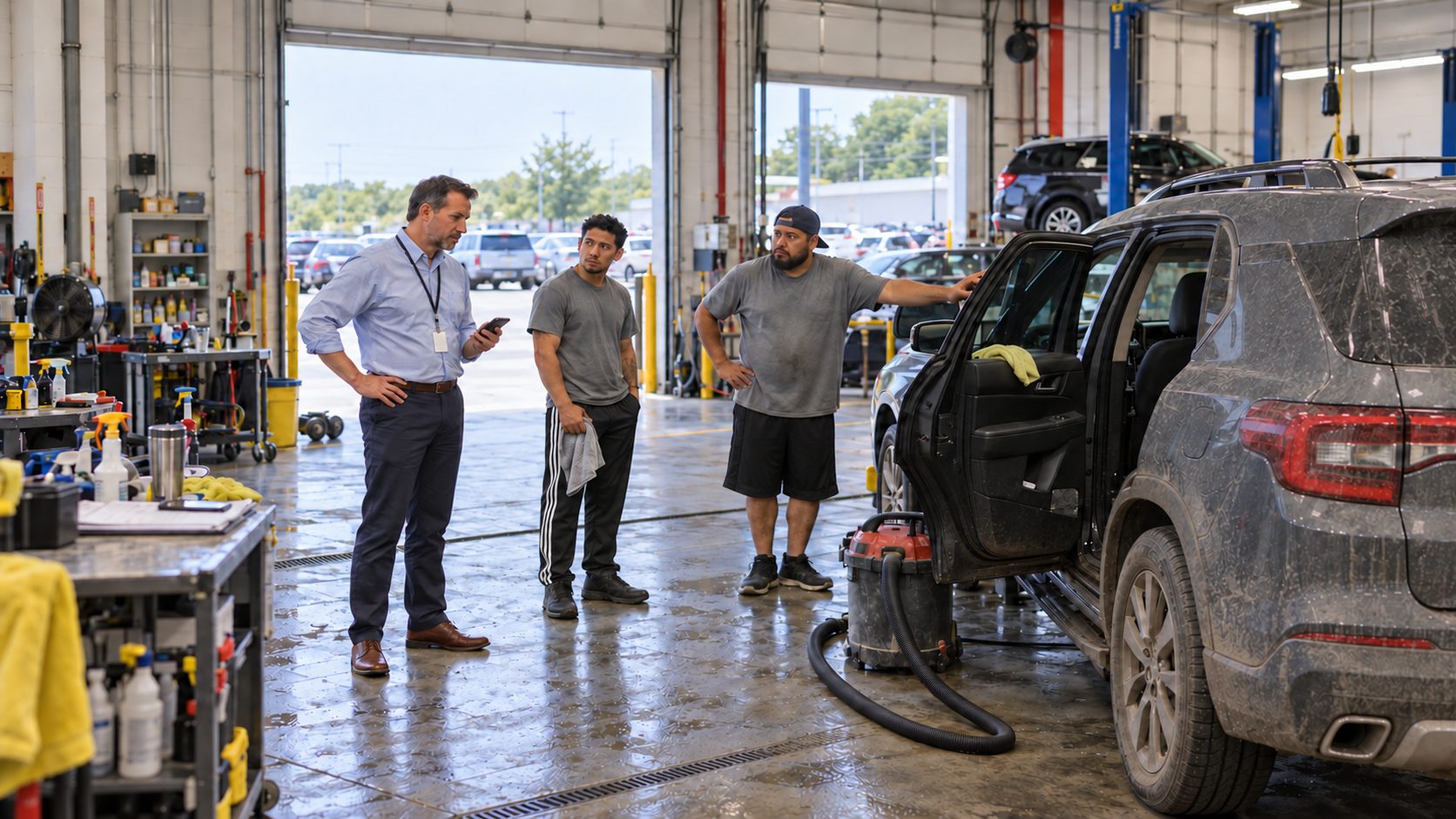
Most dealerships don’t choose a bad detail company. They choose one that seemed fine, and then slowly get used to it. The late car becomes normal. The redo becomes normal. A manager spending half an hour a day on detail becomes normal.
That’s what settling looks like. Not a disaster, just a steady drain that nobody puts on a spreadsheet. Here are seven signs it’s happening in your store, and what it should look like instead.
1. Your managers know your detailers by name, because they have to supervise them.
If your used car manager is telling detailers which cars to do first, checking their work and calling when someone doesn’t show, he is running your detail department. He just isn’t being paid to.
What it should look like: your managers know one name, the person who runs detail for you, and that person handles the rest.
2. You find out about quality problems from customers.
A missed interior or a dirty door jamb at delivery isn’t a detailing problem. It’s an inspection problem. If nobody checks the car before your salesperson sees it, your customer becomes the inspector.
What it should look like: every car is checked against a written standard by someone accountable for it, and problems get fixed before they leave the bay.
3. “We’re short today” is a normal sentence.
People quit, get sick and don’t show up. That’s the reality of the work. The question is whose problem it becomes. If a missing detailer means your cars wait, the vendor has handed their staffing problem to you.
What it should look like: coverage is the operator’s job. You shouldn’t know someone called out unless you ask.
4. Quality depends on who’s working that day.
If you can tell the difference between Tuesday’s cars and Thursday’s cars, there is no standard. There are just individual habits.
What it should look like: one written standard, trained into every person, checked every day. The car looks the same no matter who touched it.
5. Every morning, someone from your team has to tell detail what’s first.
A delivery at ten, three trades for the line, a loaner going out at noon. If detail doesn’t know that until one of your managers walks back and says it, detail is reacting, not operating.
What it should look like: priorities are set with your managers at the start of the day, and deliveries are protected first without anyone having to ask.
6. Nobody above the worker level has been in your store this month.
Ask yourself when someone from your detail company’s leadership last walked your lot. If the only people you ever see are the ones holding a towel, there is nobody watching the operation, so you are.
What it should look like: a leader on site every day, and someone above that leader in your store every week, checking quality and talking to your managers.
7. When you complain, things get better for a week.
This is the clearest sign of all. A real fix changes the process. A temporary fix changes behavior until everyone forgets. If you’ve had the same conversation three times, you’re not getting fixes, you’re getting apologies.
What it should look like: a problem gets traced to its cause, the process changes, and you don’t have that conversation again.
Why it happens
None of this means your detailers are bad people or don’t work hard. Most of them work very hard. The problem is structural. Most detail companies sell labor: people who can clean cars. Nobody in that model is responsible for the department itself, so the department falls back on the one group that can’t ignore it, your managers.
A dealership doesn’t need someone who can wash cars. It needs a department that runs at the pace and pressure of a franchise store, and owns its results instead of waiting to be chased.
What to do if you recognized your store
Count how many of the seven signs apply. If it’s three or more, your managers are running a department that should be running itself. For a fuller check, take the five-minute Detail Department Scorecard.
Prime One operates the detail department inside franchise dealerships: a Prime One manager on site every day, a trained team, and an Operations Manager in your store every week.